
The Importance of Proper Tire Pressure for Texas Drivers
Proper tire pressure is an important part of vehicle maintenance. Tire pressure is measured in pounds per square inch (PSI). The correct PSI helps your tires work as designed, supports handling, and can improve fuel efficiency. The Tire Pressure Monitoring System (TPMS) alerts you when your tire pressure drops significantly below the recommended level.
For Texas drivers, regular checks are especially useful because temperature changes, hot pavement, long commutes, and highway driving can all affect tire performance. Fortunately, checking your pressure is quick and easy.
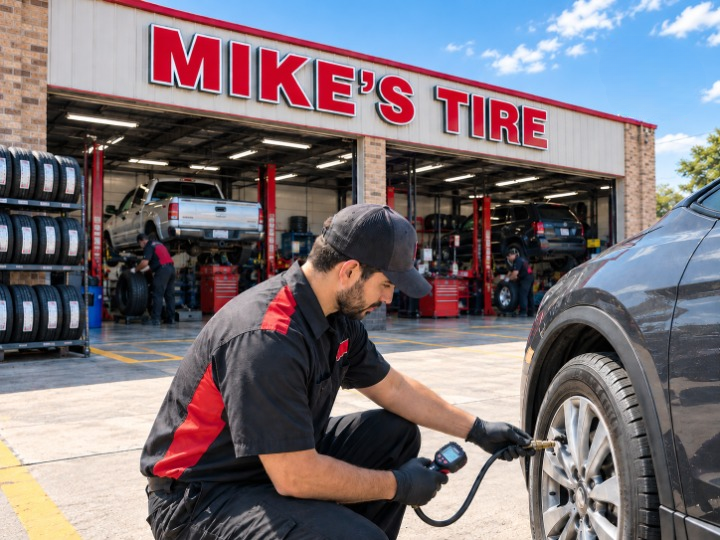
Why Proper Tire Pressure Matters
Every vehicle has a manufacturer-recommended tire pressure. Driving above or below that level can affect the way your vehicle handles and how evenly your tires perform.
Correct inflation can help with:
- Steering and handling
- Braking response
- Fuel efficiency
- Tire performance
- Ride comfort
- Detecting slow leaks early
The recommended PSI is usually printed on the driver’s door placard or listed in the owner’s manual.
Underinflation vs. Overinflation
Both conditions can create problems, but they affect a tire differently.
Underinflated Tires
When a tire has too little air, it flexes more as it rolls. This can increase rolling resistance and heat buildup. Drivers may notice:
- Reduced steering response
- Poorer fuel economy
- A tire that appears lower than the others
- The TPMS warning light
- A gradual loss of air
If the same tire keeps losing pressure, adding air is only a temporary solution. The tire should be checked for a puncture, valve issue, or other leak.
Overinflated Tires
Too much air can change the tire’s contact with the road and make the ride feel harder. It may also contribute to uneven wear.
Therefore, avoid adding extra air simply because you think higher PSI will improve performance. The manufacturer’s recommended number is the better guide.
How Texas Weather Affects Tire Pressure
Temperature changes can cause tire pressure readings to rise or fall.
When the temperature increases, the air inside a tire expands. When temperatures drop, pressure decreases. As a result, your readings may change between a hot summer afternoon and a cooler morning.
This does not mean you should release air from a hot tire simply because the reading is higher. Instead, check your pressure when the tires are cold and adjust them according to the vehicle manufacturer’s specifications.
Texas drivers should be particularly aware of this during major seasonal temperature changes.
How Often Should You Check Tire Pressure?
Checking your tires at least once a month is a simple maintenance habit. It is also smart to check them before a long road trip.
Make an extra check when:
- The seasons change
- Your TPMS warning light comes on.
- You notice unusual handling.
- A tire has recently been repaired.
- Your vehicle has been parked for a long period.
- You are preparing for extended highway driving.
A regular schedule makes it easier to spot gradual pressure loss.
How to Check Tire Pressure
You can check PSI yourself with a basic tire-pressure gauge.
Step 1: Check the Tires When Cold
Measure pressure before driving or after the vehicle has been parked long enough for the tires to cool.
Step 2: Find the Recommended PSI
Check the driver’s door placard or owner’s manual for your vehicle’s recommended pressure.
Step 3: Measure Each Tire
Remove the valve cap and firmly place the gauge on the valve stem. Record the reading and repeat the process on all four tires.
Do not assume that one tire has the same pressure as the others.
Step 4: Add or Remove Air as Needed
If a tire is below the recommended level, add air gradually and check the reading again.
Replace the valve cap when finished.
When Should You Get Professional Help?
Some tire-pressure problems are easy to correct at home. Others require a professional inspection.
Visit a tire professional if:
- The same tire repeatedly loses air.
- Your TPMS warning keeps returning.
- A tire has visible damage.
- You are unsure about the correct PSI.
- The vehicle handles differently after a pressure problem.
- You are preparing for a long road trip.
If you are searching for a tire shop in Lewisville, Mike’s Tire provides tire services, tire repair, new and gently used tires, wheels, and vehicle state inspection services.
For drivers looking for a tire shop in Azle, Mike’s Tire’s Azle location also provides tire-related services and vehicle inspections.
Make Tire Pressure Checks Part of Your Routine
Checking tire pressure takes only a few minutes, but it can help you identify problems before they interfere with your driving.
If you are unsure whether your tires are properly inflated or one keeps losing air, Mike’s Tire can inspect them and help you determine the right solution.
Mike’s Tire – Lewisville, TX
Address: 300 E State Highway 121 Business, Lewisville, TX 75057
Phone: (972) 956-0433
Phone: (972) 956-0433
Mike’s Tire – Azle, TX
Address: 101 Southeast Parkway, Azle, TX 76020
Phone: (817) 752-2166
Phone: (817) 752-2166
Visit us in Lewisville or Azle for your tire and inspection needs.